
The roller surface fatigue layer must be removed before cladding.
Case Detail
Laser Cladding Repair for Laminar Cooling Rollers
Surface restoration and strengthening for hot strip line rollers
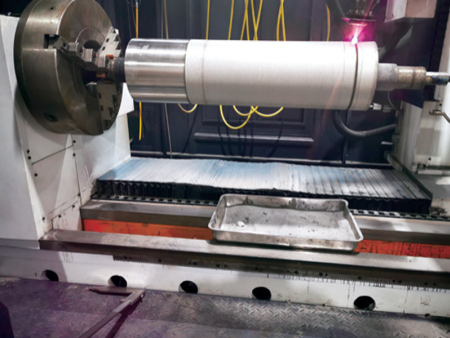
Laminar cooling rollers are positioned between the finishing mill and coiler in hot strip lines. The roller surface works under combined temperature, impact, wear and corrosion conditions, so repair planning must consider fatigue-layer removal, cladding performance and finishing accuracy together.
Challenges
Final dimensions and surface roughness must meet drawing requirements.
Diameter, hardness and penetrant testing are key to crack-risk control and delivery quality.
Approach
1. Remove the roller surface fatigue layer by turning.
Remove the roller surface fatigue layer by turning.
2. Check roller diameter and hardness and perform penetrant testing.
Check roller diameter and hardness and perform penetrant testing.
3. Use 250-300 C preheating as part of process preparation.
Use 250-300 C preheating as part of process preparation.
4. Apply high-power laser cladding to form a wear-resistant and corrosion-resistant layer with HRC55-HRC60 hardness and 800 C high-temperature resistance.
Apply high-power laser cladding to form a wear-resistant and corrosion-resistant layer with HRC55-HRC60 hardness and 800 C high-temperature resistance.
5. Reserve machining allowance
Reserve machining allowance, then grind to drawing requirements and complete final inspection.
Project Highlights
| Type | Description |
|---|---|
| Product type | Laminar cooling roller repair and surface strengthening |
| Process data | HRC55-HRC60; 800 C high-temperature resistance; 250-300 C preheating |
| Workflow | Turning, inspection, preheating, high-power laser cladding, semi-finishing, grinding and final inspection |
| Project records | 79 image/video records for laminar roller repair |
| Capability | Laser cladding product and service system |
Service Notes
Suitable for laminar roller repair, roller surface strengthening and laser cladding service discussions.
For project communication, please confirm the service type, component type, process route, inspection requirements, delivery schedule and site conditions.
Inquiry Checklist
Project Detail Index
Laser Cladding Repair for Laminar Cooling RollersLaminar cooling rollers are positioned between the finishing mill and coiler in hot strip lines. The roller surface works under combined temperature, impact, wear and corrosion conditions, so repair planning must consider fatigue-layer removal, cladding performance and finishing accuracy together.Rolling Mill Bearing Housing RepairRolling mill bearing housings work under impact load, vibration and changing lubrication conditions. Common issues include worn bearing positions, local scoring, mating-surface dimensional change and reduced assembly accuracy. Repair planning must consider reference alignment, material condition, machining allowance and inspection requirements.On-site Repair for Mill Housings and Bearing HousingsRepair scope includes on-site mill housing repair, roll bearing positions, bearing housings, guides, pinch rollers, gear shafts and motor shafts. These parts are closely related to line stability, shutdown windows and assembly accuracy.Looper Roller Machining and RepairLooper rollers are used for strip tension adjustment and strip running control. Roller surface condition affects line stability, so project communication should confirm roller diameter, surface wear, shaft-end fits, roughness and installation requirements.Mill Liner Plate Manufacturing and RepairMill liner plates provide support, guidance and wear resistance. They may develop wear, scoring, deformation or assembly-gap changes. This case presents liner plate manufacturing, repair, wear strengthening and drawing-based processing capabilities.Upper and Lower Pinch Roller Manufacturing and RepairUpper and lower pinch rollers are used for strip pinching, pulling or transition conveying. Surface wear, indentation, corrosion or shaft-end fit issues can affect operation stability. Project communication should focus on surface material, hardness, dimensional accuracy and surface treatment.Roll Alloying and Nano-StrengtheningRoll surface strengthening is suitable for operating areas with high wear, corrosion and fatigue risk. Laser alloying, laser cladding and related surface engineering routes can be planned around material systems, hardness targets, wear requirements and finishing accuracy.Dredging Equipment Component SupplyThe product portfolio covers cutter suction, bucket wheel, trailing suction and marine structural part categories, including cutter heads, jet nozzles, traverse pulley assemblies, grab buckets, drag heads, wear blocks, tees, elbows, steel pile clamps and floating pontoons.Dredging Cutter Head Manufacturing and SupplyThe cutter head is a key working component for cutter suction dredgers and desilting equipment. Structure, arms, tooth seats, interfaces and wear-resistance requirements are usually confirmed by vessel type, power, soil condition and construction environment.Dredging Cutter Teeth and Wear PartsCutter teeth and wear parts directly cut and break sand, clay, gravel and other media, making them frequently replaced dredging consumables. Selection should consider tooth shape, tooth-seat matching, material, heat treatment, wear layer and stable batch supply.Drag Heads and Drag Head Wear BlocksDrag heads, drag head wear blocks and pipe connection parts are used on trailing suction dredging equipment and work in underwater, abrasive media. Project communication should confirm vessel type, pipe diameter, interface, wear position, material and wear treatment.Steel Pile Clamps and Floating Pontoon StructuresSteel pile clamps, floating pontoons and similar structures serve vessel, dredging and hydraulic engineering scenarios. They are usually fabricated according to structural drawings, load, welding, corrosion protection, transport and site installation conditions.