
Surface restoration for rollers after wear, corrosion or fatigue-layer removal
Workshop or on-site repair routes are determined by component damage, drawing requirements and site conditions.
Service Detail
Laser cladding is used for surface restoration and performance strengthening after wear, corrosion, scoring or dimensional loss. TSHAIGONG designs, develops and produces laser cladding equipment and provides laser cladding processing services.
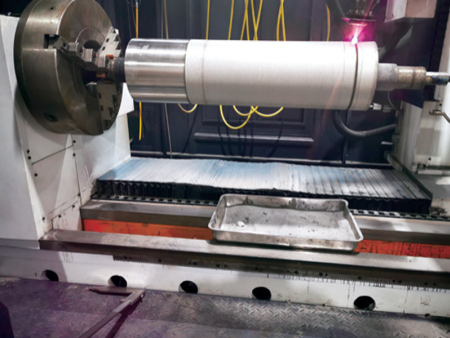
Workshop or on-site repair routes are determined by component damage, drawing requirements and site conditions.
Workshop or on-site repair routes are determined by component damage, drawing requirements and site conditions.
Workshop or on-site repair routes are determined by component damage, drawing requirements and site conditions.
Workshop or on-site repair routes are determined by component damage, drawing requirements and site conditions.
Confirm damage location, base material condition, restoration target and inspection scope.
Remove the failed layer by turning, grinding or local machining to prepare a stable base.
Review diameter, hardness and crack risk; laminar cooling roller repair may include penetrant testing and 250-300 C preheating.
Select cladding material and process window according to the working condition.
Restore dimensions, geometry and surface roughness by semi-finishing, grinding or other finishing processes.
Confirm dimensions, hardness, surface quality and required NDT before delivery.
| Item | Description |
|---|---|
| Processing Equipment | 6 laser cladding units for external processing |
| Laminar Cooling Roller Data | HRC55-HRC60; 800 C high-temperature resistance |
| Preheating | 250-300 C |
| Related Processes | Laser cladding, laser quenching, laser welding and laser alloying |
The technical team can confirm repair plans based on component condition, drawings, site conditions and inspection standards.
Contact
For product inquiries, repair assessment, on-site service or technical discussion, please contact TSHAIGONG by phone or email.
Please include the product name, industry, component condition, drawings or sample status when contacting us.